

8th Spring School of Evolution
23-24 May 2026, University of Wrocław, Wrocław (Poland)
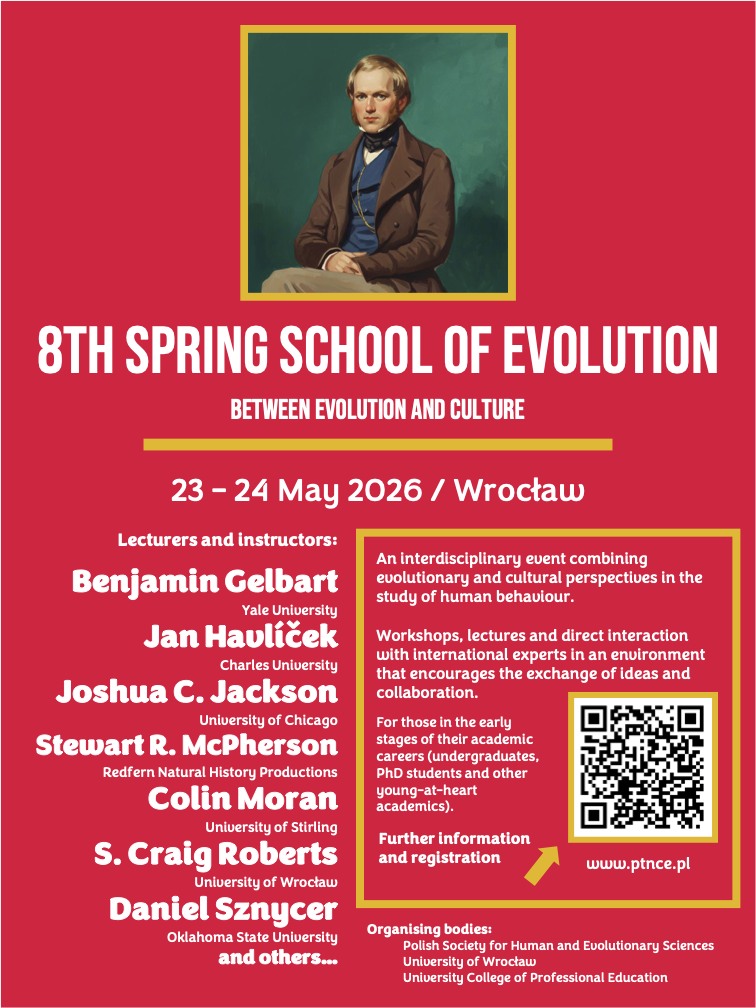
Date & Venue: 23-24 May, Wrocław, University of Wrocław (opening ceremony in the Leopoldina Hall, sessions at the Faculty of Philology, Wyspa Piasek)
This interdisciplinary educational event has, since 2014, brought together people interested in the scientific study of human behaviour from an evolutionary and cultural perspective.
It brings together people at various stages of their careers: from undergraduates and PhD students to experienced researchers from Poland and abroad. The common thread is a curiosity about human nature and a desire to develop their own research projects.
The event combines lectures and workshops, creating a space for learning, discussion, and establishing collaborations.
The Spring School has been organised for 12 years by Dr Piotr Sorokowski, together with his colleagues. In 2026, the co-organisers are Dr Artur Ziółkowski, Dr Marta Kowal, and Dr Michał Misiak.
Who is it for?
The event is open to anyone interested in a scientific approach to human behaviour – regardless of their field of study.
We particularly welcome students, PhD candidates, and anyone interested in developing an academic career and conducting research. Priority will be given to applications from those at an early stage of their academic career.
At the same time, we invite people at all stages of their careers to participate – regardless of age, academic rank, or title. For those with greater academic experience, eligibility may be determined, among other things, by their previous involvement in the activities of the Polish Society for Human and Evolutionary Sciences (PTNCE).
Registration (closed)
Participation in the event requires prior registration via the registration form.
The form includes basic information (including affiliation) and a brief statement of reasons for participation, including a description of your previous involvement in academic activities.
Deadline for applications: 26 April 2026
Notification of selection results: 30 April 2026
Places are limited. In the event of a high number of applications, selection will be based on an assessment of the information provided.
• The event does not involve active participation by attendees in the form of paper or poster presentations.
• Participation in the School is free of charge. The costs of organising the event will be covered by the organisers. Participants are responsible for covering their own travel costs to Wrocław and any accommodation expenses.
Mission
The School’s aim is to support the development of young researchers and to promote evolutionary and cultural perspectives in research into human behaviour.
The School also serves as an integrative platform, facilitating research collaboration between participants and invited academics. For those considering a PhD, it also offers an opportunity to meet potential supervisors.
Guest speakers and session topics
(detailed descriptions of the speakers at the bottom of the page)
Benjamin Gelbart, Yale University
– How to conduct research using the HRAF database
Jan Havlicek, Charles University
– How to conduct olfactory research
Joshua C. Jackson, Chicago University/Harvard University
– Doing (and publishing) interdisciplinary research: Lessons from three papers (including one in Science)
Marta Kowal, Uniwersytet Wrocławski
– How to conduct cross-cultural research
Stewart R. McPherson, Redfern Natural History Productions
– Science communication: retracing Darwin’s journey on the HMS Beagle
Michał Misiak, Uniwersytet Wrocławski
– Workshop on effective teamwork
Colin Moran, Stirling University
– How to conduct genetic research on HLA
S. Craig Roberts, Uniwersytet Wrocławski
– How to become an impactful scientist
Natalia Siekiera, Uniwersytet Wrocławski
– Ethological research: how to observe human behaviour
Piotr Sorokowski, Uniwersytet Wrocławski
- Everything you’d like to know about a PhD (admission to a doctoral programme, choosing a supervisor, scholarships, etc.) but don’t know who to ask
Daniel Sznycer, Oklahoma State University
– Value computation in humans
Artur Ziółkowski, University College of Professional Education
– The art of public speaking
Guest Speakers
Benjamin Gelbart
A psychologist affiliated with Yale University and the HRAF (Human Relations Area Files), which maintains the world’s largest database on cultures. In his research, he analyzes the cross-cultural determinants of emotions and the ways they are expressed. He combines psychological and anthropological perspectives, drawing on comparative data from hundreds of cultures. He publishes in journals such as Psychological Science, Nature Scientific Data, and Evolution and Human Behavior.
Jan Havlíček
Professor at Charles University in Prague, specializing in human ethology and chemical communication. He studies the biological and evolutionary foundations of social behavior, particularly the role of olfactory signals and the mechanisms shaping first impressions. His work combines biological and psychological perspectives in the analysis of social perception. He currently serves as president of the International Society for Human Ethology.
Joshua C. Jackson
Professor of behavioral sciences at the University of Chicago, affiliated with Harvard University since 2026. His research focuses on the intersection of cultural evolution and psychology. He analyzes how the human psyche changes alongside the development of societies: their size, complexity, and degree of interconnectedness. He studies both long-term social processes (e.g., the emergence of states) and contemporary phenomena, such as the development of technology and social media, in relation to morality, emotions, and belief systems. He publishes regularly in Science, Nature Human Behaviour, and PNAS.
Marta Kowal
A psychologist and researcher at the University of Wrocław. Her work focuses on the psychology of romantic relationships and physical attractiveness from a cross-cultural perspective. She is a co-author of one of the largest studies to date on love and mate preferences, encompassing over 117,000 participants from 175 countries. She is a recipient of the START scholarship from the Foundation for Polish Science and has been awarded two research grants (PRELUDIUM and SONATA) funded by the National Science Centre.
Stewart R. McPherson
British science communicator, traveller, and field biologist. Author of numerous books and documentaries on natural history, particularly renowned for his research into carnivorous plants. Founder of Redfern Natural History Productions. He has co-discovered and described many plant species whilst conducting research in Asia, Africa, and South America. Initiator of the ‘Ark of Life’ project and recipient of the David Given Award for Excellence in Plant Conservation. Between 2023 and 2025, he led an international expedition commemorating the voyage of the HMS Beagle.
Michał Misiak
A psychologist and researcher affiliated with the University of Wrocław and the University of Oxford. He specialises in social psychology, with a particular focus on cooperation, social norms, and food-related behaviours (including food waste). He conducts experimental and cross-cultural research, combining a psychological approach with an anthropological perspective. He is involved in Big Team Science initiatives and conducts fieldwork in non-industrialised communities. He is the creator of a course focusing on effective teamwork.
Colin Moran
A geneticist and researcher at the University of Stirling, specialising in the genetic and epigenetic underpinnings of individual differences in sport and health. One of the leading experts in HLA research. He analyses why people respond differently to the same training and health interventions and how to personalise recommendations based on biological profiles. Co-founder of international research projects (including Athlome and ELITE) and research into The Daily Mile programme.
S. Craig Roberts
An evolutionary biologist and psychologist affiliated with the University of Stirling and the University of Wrocław. He studies the biological foundations of social behaviour, including signals of health and attractiveness in the context of mate selection. He analyses, amongst other things, the role of the MHC, facial features, and body odour in social preferences. In his work, he combines experimental methods with interdisciplinary approaches. Author of publications in Nature and a book published by Oxford University Press, former president of the International Society for Human Ethology, and recipient of a Wellcome Trust Discovery Award.
Natalia Siekiera
She recently completed her PhD at Jagiellonian University and has taken up a post at the University of Wrocław, where she conducts research in the fields of cultural developmental psychology and cross-cultural psychology. She specialises in observational methods derived from ethology, with a particular focus on the analysis of children’s social behaviour. She has conducted observational fieldwork in Bolivia and Peru. She runs workshops on observation and behavioural analysis and collaborates internationally, including with the University of Münster, on projects analysing children’s prosocial behaviour in natural settings, with a particular focus on interactions with parents. Winner of the Linda Mealey Award.
Piotr Sorokowski
Researcher at the University of Wrocław. His work focuses on cultural and evolutionary psychology in the broadest sense, as well as environmental and biological foundations of behaviour. He is one of the few psychologists in the world specialising in research into traditional societies in Papua, Africa, and the Amazon. His interdisciplinary research has been published in journals such as Nature, Nature Human Behaviour, and PNAS; he ranks among the top 2% of most-cited scientists according to the Ioannidis/Stanford University ranking.
Daniel Sznycer
Professor of Psychology at Oklahoma State University, a social psychologist who applies an evolutionary perspective to the study of emotions and morality. His work focuses on phenomena such as shame, pride, compassion, and jealousy, and their role in cooperation, altruism, and conflict. He conducts extensive cross-cultural research, utilising methods such as experimental economic games, surveys, and ethnographic approaches. He publishes in PNAS, Nature Human Behaviour, and Science Advances.
Artur Ziółkowski
Psychologist, holder of a habilitation degree. Dean of the Faculty of Psychology at the University College of Professional Education. Author of numerous academic publications in the fields of health sciences and physical education. Practitioner of organisational and occupational psychology. Experienced trainer and workshop leader. He has completed postgraduate studies in psychotherapy and sports psychology.
Organisers
Head of the Organising Committee: Dr Piotr Sorokowski, Professor at the University of Wrocław
Committee members: Dr Marta Kowal, Dr Michał Misiak, Dr Artur Ziółkowski
Organising bodies:
Polish Society for Human and Evolutionary Sciences
University of Wrocław
University College of Professional Education